

The modern-day wheelchair is used by millions of people with disabilities around the world. The history of wheelchairs shows us how technological advancements have been driven by the changing demands, circumstances, and ingenuity of wheelchair users throughout time.
Ancient Times
While it is uncertain as to what can be considered the first wheelchair, stone inscriptions from Ancient China and Greece suggest that wheelchair-type furniture has been used at least since the sixth century AD. The written first records of wheeled seats being used for transporting disabled people date to three centuries later in China.
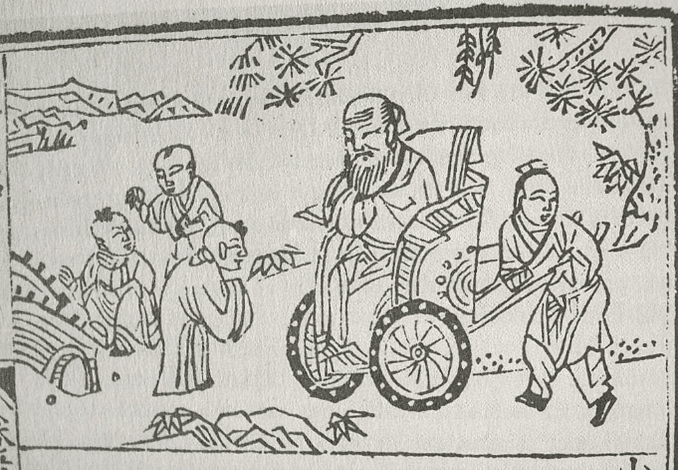

The 16th -17th Centuries
One of the best-documented early examples of a wheelchair was made by an unknown inventor for King Philip of Spain (1527-98), in 1595, who in his later years suffered from severe gout which made walking difficult. This chair was elaborate in its design with plush upholstery, arm and leg rests, and four small wheels which meant that he needed to be pushed around by a servant.
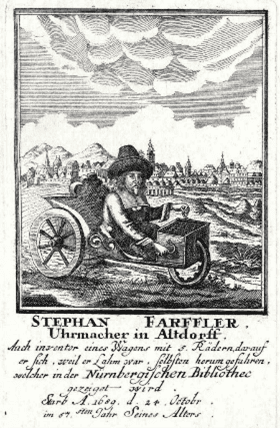
It’s easy to assume that self-propelled wheelchairs are a modern invention, but they’ve been around in one form or another for longer than you might think. The first self-propelled wheelchair was invented in 1655 by Stephan Farffler (1633-1689), a clockmaker from Nuremberg, Germany who had paraplegia. He built his own mobility aid at 22 years old after having broken his back as a child. Farfler’s wheelchair frame was based on a three-wheel chassis and worked by turning handles attached to a geared front wheel using a system of cranks and cogwheels.


The 18th-19th Centuries
In the mid-18th century, Bath England was the epicenter of technological advancements for wheelchairs. The town was a popular destination for the sick and disabled from across Europe hoping to benefit from the healing properties of the mineral waters as well as the physical therapy offered in the area. To meet the demand created by immobile visitors wishing to visit the waters, several wheelchairs were designed and became available to rent.
The most popular design of this period was John Dawson’s 1783 Bath Chair, a model supported by two wheels joined by an axle underneath the seat with a small pivoting wheel in front of the supporting footrest. The Bath Chair could be steered by the rider via a long, curved rod connected to the front wheel. It also could be mounted on four wheels, allowing the rider to be transported by a horse, donkey, or small pony.
Variations of the Bath Chair quickly became very popular across Britain and soon rivalled the Sedan Chair (an enclosed box with a seat carried on poles by two men) as a form of transportation for wealthy disabled people. Queen Victoria even had a custom Bath Chair made as a mobility aid in her later years.
Patents show that throughout the nineteenth century many improvements were made to the wheelchair to promote comfort, maneuverability and independence, including the invention of rear push wheels and push-rims.
The 20th Century
Benefiting from the many technological advancements made during the industrial revolution, significant progress was made with wheelchairs in the 1900’s. In 1916 the first motorized power wheelchair was invented in London.
Then in 1933: Mining engineer Herbert Everest, who had been paralyzed in a mining accident, was looking to improve his mobility as he felt confined by his current wooden wheelchair. With the help of friend and mechanical engineer Harry Jennings, he improved the folding wheelchair using technology and materials originally developed for airplanes to make it lighter and more practical for use inside and outside the home.
The company they started soon after, Everest & Jennings, dominated the wheelchair market for much of the 20th century.
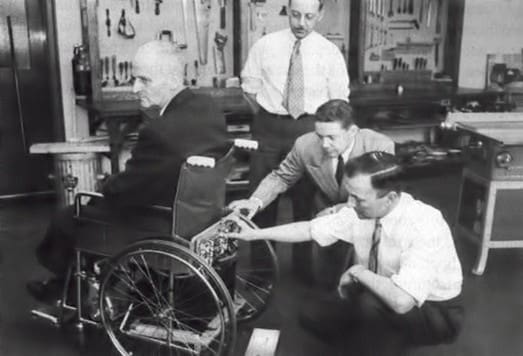
Following World War II, The Klein Drive Chair was developed to assist injured veterans’ thanks in part to the advocacy of a disabled WWI survivor by the name of John Counsell.
Although a patent was issued in 1950 to Sam Duke for an add-on motor that could be attached to a manual wheelchair, the power wheelchair and the inventor George Klein will be forever linked. One of Canada’s most productive inventors in the 20th century, Klein, is credited for the invention on a successful and marketable level. Klein developed a package of technologies that included: a joystick, separate wheel drives, tighter turning systems.
After its success in Canada, the prototype Klein wheelchair was transferred to the U.S. Department of Veterans Affairs along with patent-free rights to encourage production in the United States. Power wheelchairs became available en-masse within a few years when Everest & Jennings began large scale production in 1956.
During the 1970s, power chairs were fragile, with limited capabilities, and were regarded by manufacturers and society as solely an institutional device. The 1973 Rehabilitation Act, a precursor to the Americans with Disabilities Act (ADA), aimed to change this and ignited a large-scale increase of wheelchair ramps in public buildings. Prior to this, there wasn’t much motivation to provide wheelchairs for use outdoors since the lack of ramps and elevators made it hard to get around.
Innovation on power wheelchairs slowed until the 1980s when the independent living movement demanded better mobility devices. Even then, most electric wheelchairs on the market were still bulky, heavy, and required a special vehicle for transportation.
By the 1990’s the popular electric wheelchairs on the market were now foldable, although this required the removal of the leg rests and batteries, and sometimes the motors.
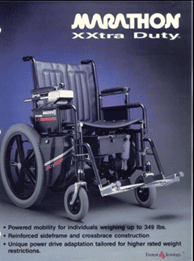
Based on consumer need, Pride released the Jazzy® Power Chair in 1996, offering industry- leading maneuverability with its patented mid-wheel drive technology, using a direct drive motor instead of gear or belt driven motors.
Digital technology opened the way for an exponential growth in innovations for power mobility. You now could have alternative drive access, powered seating systems, and a wide variety of programming options for drive settings. You could also integrate additional technology with wheelchair electronics such as communication devices, computers, & phones.
Despite these advancements, by 2006 major funding and coding changes dramatically slowed access to power chairs and innovation by manufacturers. Funding cuts reduced coverage across the board and eliminated many advanced technologies altogether. Many other technology sectors were booming with breakthroughs that could have benefitted power chairs — from battery innovations to advanced electronics. It would be 2010 before funding had stabilized enough to regain steady innovation in the industry.
Since 2015, we’ve seen major manufacturers introduce advanced technologies that are truly changing lives, from gyroscope tracking technology for improved drive control to the use of biometrics for advanced power positioning. There is also Bluetooth integration for controlling electronic devices, ultra-advanced drive controls, USB ports for hand-held devices, and ever-enhanced suspension for terrain handling.
What’s Next?
As technology continues to accelerate, the next 50 years promise remarkable breakthroughs in mobility and independence. At Mobius Mobility, innovation isn’t just a goal, it’s our everyday work. The ibot® PMD already empowers qualified and trained users to climb stairs, navigate snow, sand, and uneven terrain, and elevate to eye level. In 2025, we expanded its capabilities with optional power tilt and recline to better support comfort and clinical needs, and we’re far from finished.
If you’re curious whether the ibot® PMD could be the right mobility solution for you or someone you know, we’d love to help you explore that. Reach us at 1‑833‑346‑4268 or connect with us through our contact form.
Additional Sources: